
Grady County Arrest Log Sources
Grady County publishes no 72-hour, weekly, or multi-day booking blotter. Cairo Police and Whigham Police list no municipal arrest log either. What exists is the Sheriff’s news page. It posts selected enforcement and public-safety releases. That is not a running ledger of everyone booked. There is no archive depth, rolloff rule, or photo schedule to cite for a county blotter.
Blotter and story are not the same thing. A booking log is a straight sequence of jail intake records. A news release gets picked for public interest. It might cover a pursuit, a drug case, or a traffic sweep instead of a routine booking. It can also run days after the arrest itself. Digging through a week of news can surface one reported event. It cannot count all Grady County arrests.
Read Grady Arrest Reports Carefully
Anchor everything to the event date, not the story date. A Monday article may describe a Friday arrest. Check the agency named in the report. It may not even be the office holding the person now. Names deserve the same caution. Compare the identifiers you have. Never merge two records just because the names look alike.
- Check the official Sheriff news page for a selected release. Record the event date, publishing date, named agency, and stated charge language.
- Search the WALB Grady County section for event reporting. Treat it as journalism, not the Sheriff’s complete booking system.
- Use an unofficial county page only as a lead. Check its date and source, then verify the booking with the Sheriff.
- Ask the Grady County Clerk about the matching case. Compare case numbers when possible and look for a disposition.
- Request the actual booking or arrest record when the event is older than the visible news window.
Need something same-day? The Arrests Last 24 Hours page handles urgent checks. A multi-day Grady County search works differently. It rebuilds the picture from selective news and official records once the first hours have passed.
Grady Blotter Entry Fields
No official public log offers a fixed set of columns. News stories and requested booking records each carry different data. Use this inventory to sort what a source actually states from what still needs agency confirmation.
| Possible item | How to interpret it |
|---|---|
| Name | Identity as published or entered, subject to spelling and alias corrections. |
| Event date | The alleged incident or arrest date, which may differ from the publication and booking dates. |
| Agency | The Sheriff, Cairo Police, Whigham Police, or another office involved in the event. |
| Charges | Accusations attributed to the agency or booking record, not court findings. |
| Booking number | A local intake identifier that should be requested when absent. |
| Bond or release | A status at a stated time, not the final outcome of the case. |
| Photograph | A publisher or agency image with its own source and limits; no official Grady gallery was found. |
| Disposition | The later court result, obtained from court records rather than inferred from the article. |
A story can quote an agency right away. The booking record may not be finished yet. A third-party page may leave an old photo up after custody has ended. Court files can later show dismissal, a plea, restriction, or another outcome. Keep dates and source labels attached. That keeps these stages distinct.
Grady Weekend Arrest Reporting
No evidence supports a Grady County weekend surge. There is no holiday batch either. There is no Monday posting cycle. Do not build those patterns out of a few scattered stories. Jail operations continue around the clock. Records counters and courts keep their own schedules, and the official pages publish no measured local delay. When an arrest falls late in the week, search by the arrest date across the next several days of publication. Then confirm with the Sheriff directly.
An empty news search means little on its own. The incident may have been routine, too fresh, filed under a different place name, handled by another agency, or passed over entirely. Custody may also have ended by now. The county-wide Grady County recent arrests resource separates current custody, booking records, court status, state custody, and other official channels.
Note: A weekend article count is not a booking total, and a Monday story date does not fix when the arrest happened.
Grady Arrest News Is Selective
The Sheriff’s news page carries the office’s public-facing enforcement and safety releases.
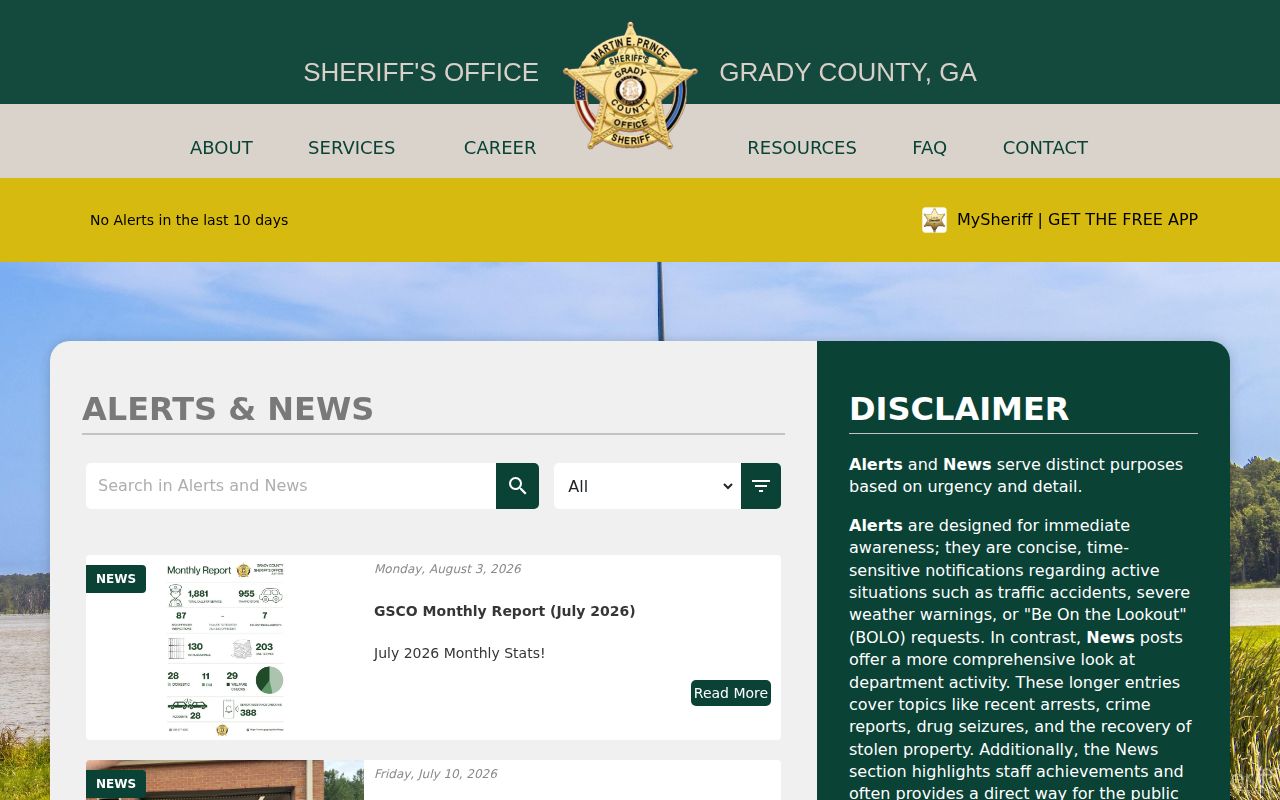
The page shows one source type, not a roster. It does not establish daily publication or prove that unreported bookings never happened.
WALB's Grady County section also runs event-based local reports. Its stories draw on Sheriff statements and cover pursuits, drug cases, and traffic enforcement. That explains why one arrest became news while others did not. It says nothing about how many people entered the Grady County Detention Facility. The same stretch goes uncounted.
Triangulate. Set the agency release beside the news account and request the booking record. Then follow the case at the Grady County Clerk. Where details conflict, the court record controls the legal outcome. The jail record stands as proof of intake.
Unofficial Grady Arrest Archives
Beyond official sources, two secondary paths can offer leads. WALB is a news outlet, and The Georgia Gazette runs a Grady County arrest-page section. Neither is the county's booking log. Coverage can be incomplete or stale. It may be quietly corrected or limited to certain events. A photo on either site should never land in a face gallery. The Georgia Gazette's unofficial Grady County section shows what that secondary landscape looks like.
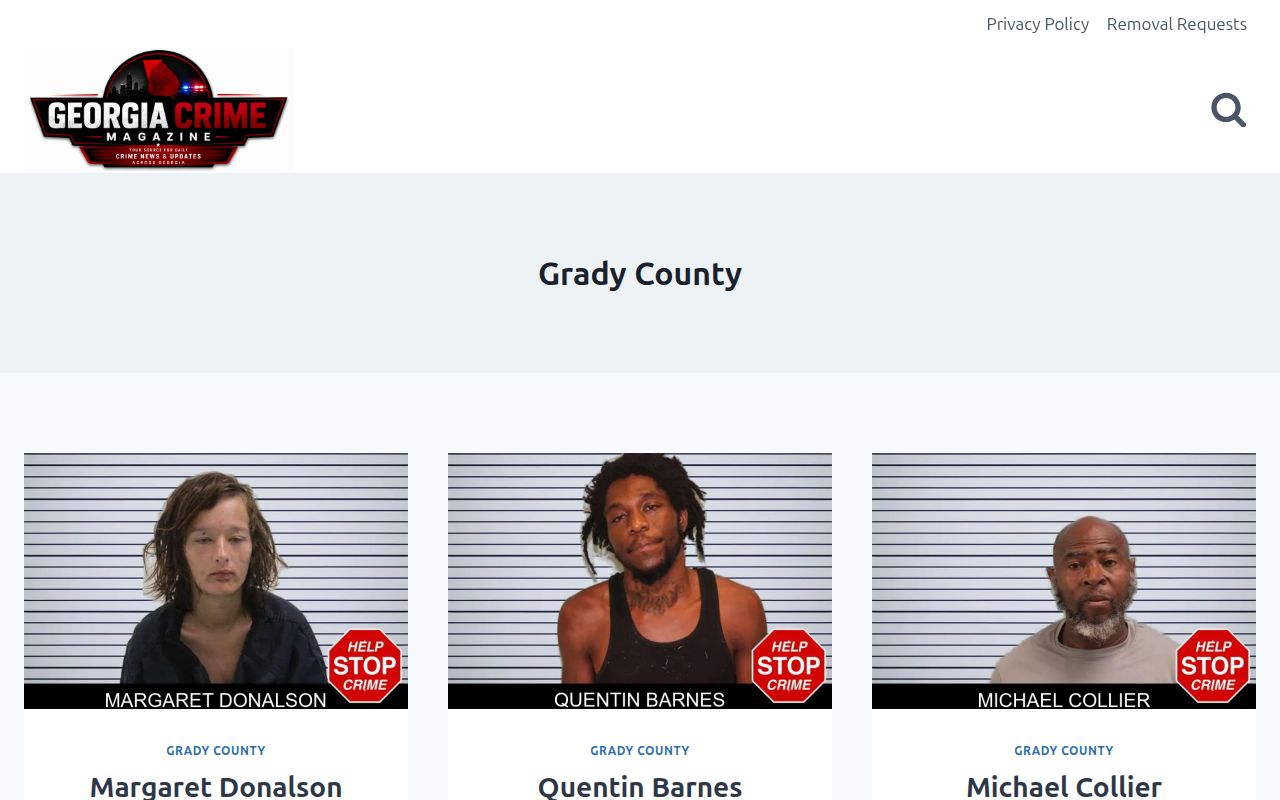
That page appears here to identify the publisher and its limits. It does not certify any current arrest. Mugshots.com once had a Grady County route but serves as no same-day source. Busted Newspaper returns not found on its expected Grady path. RecentlyBooked is gone. Mugshots.zooe has no live county page. Fill those gaps with real Grady County sources, not generic state pages. An old third-party profile proves neither current custody nor a current charge.
Grady Booking Archives and Retention
Retention rules and online access are two separate things in Grady County. The Georgia Archives local-government schedule sets minimums. It covers how long agencies keep records, not what the public can browse. Jail booking records stay in the series for ten years. That clock runs after release. Jail registers get ten years after the date of the last entry. Daily incarceration lists carry only a one-year schedule. Open Records requests themselves are listed for three years. A legal hold, an exemption, an approved destruction, or a series classification can change any outcome.
A booking record can outlive the web page that once showed it. Sometimes the record exists but holds protected data. Staff must redact that material first. A third party may even keep a copy after an agency changes its page. So ask the Sheriff directly. Does the booking record remain in the local series? After that, did it transfer somewhere else, and which schedule entry governs it?
Names that sound alike get treated differently too. Registers and daily incarceration lists are not the same series. Their periods differ. Neither one builds an online archive of Grady County arrests. When staff cannot find a booking, ask which series they searched. Also ask whether a hold, transfer, or approved destruction played a part.
To request an actual booking record, use the Sheriff's Open Records form. Include the person's full name, approximate booking dates, the likely agency, and a booking number if you have one. List the booking record and any releasable image as separate items. Ask for a cost estimate and an explanation of any exemption. The form promises no special photograph fee and no set response time.
Note: Retention schedules guide record management; they do not guarantee that a Grady booking image remains online, public, or available without redaction.
Grady Arrests Require Court Follow-Up
An arrest report tells you who was booked, not how a case ends. The eventual outcome has a name: disposition. That answer lives in the court record, not in a Sheriff release or a publisher page. A booked charge can shrink, fall away, divert, resolve by plea, or go to trial.
The Grady County Clerk handles Superior, State, and Juvenile Court functions. Its case system is the natural next stop. Georgia Courts eAccess offers another route. Access conditions and available fields vary between them. Compare case numbers and identifying details carefully. If no disposition appears, report it that way. Do not treat the original charge as the final word.